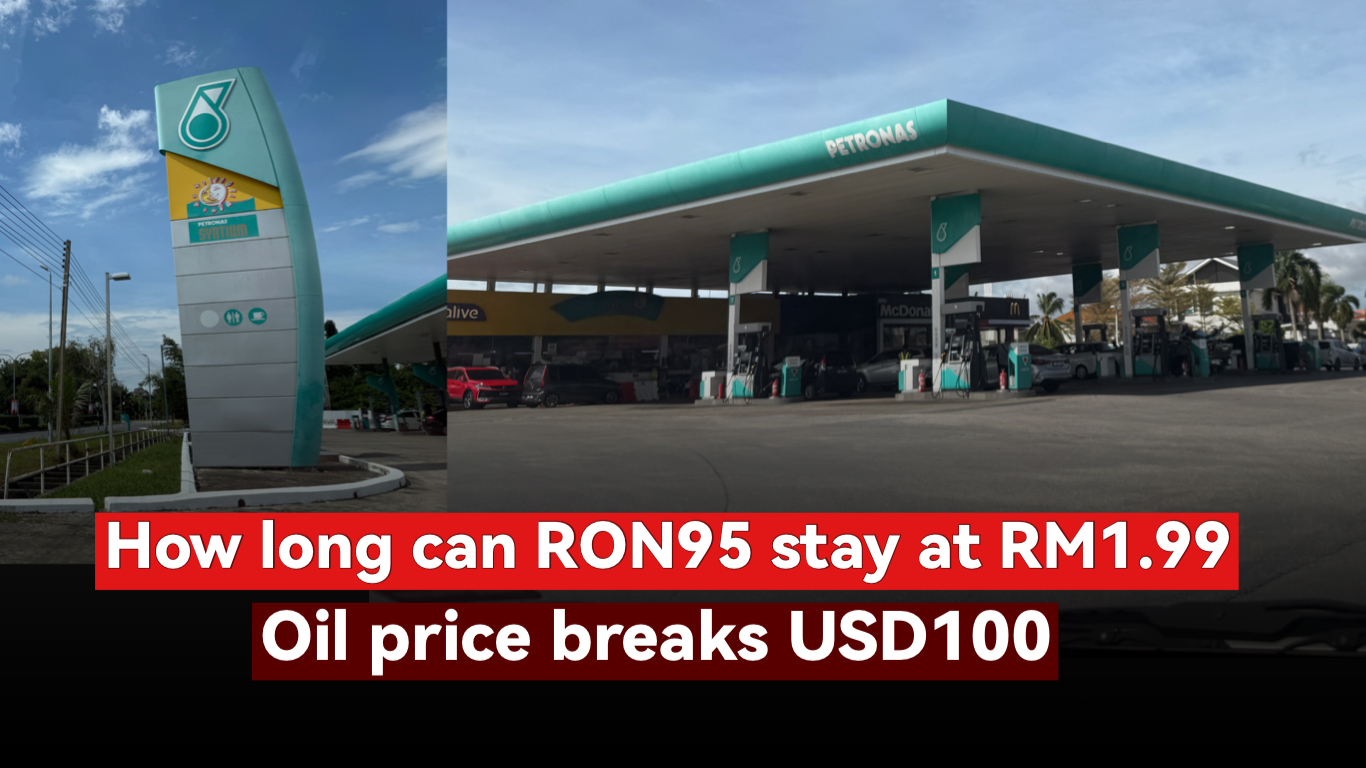
How long can RON95 stay at RM1.99? Oil price breaks USD100, government says subsidy may last only 2 months
Recently, global oil prices have surged again.
Brent crude oil has already exceeded USD100 per barrel, and at one point even approached USD115.
The Malaysian government has stated that the current RON95 subsidised price of RM1.99 per litre can likely be maintained for about two more months under current conditions.
This statement immediately raised concerns among many people:
Will RON95 increase soon?
However, the situation is actually more complex.
⸻
Why higher oil prices are not entirely bad for Malaysia
Many people may not realise that Malaysia is actually a net energy exporter.
In simple terms:
• Malaysia imports petrol
• But at the same time, the country exports large amounts of crude oil and natural gas
Much of the revenue from these resources comes from the national oil company:
PETRONAS (Petroliam Nasional Berhad)
When global oil prices rise:
• PETRONAS earns more revenue
• The government receives higher dividends from PETRONAS
So rising oil prices can have both positive and negative effects for Malaysia.
⸻
Why the government still says the subsidy may last only 2 months
Many analysts believe there could be two key reasons behind this.
1. Oil revenue distribution is changing
For decades, oil-producing states only received 5% oil royalty.
However, in recent years,
the Sarawak government has negotiated and used legal avenues to obtain greater control and revenue from oil and gas resources.
Overall estimates suggest that Sarawak may now receive around 30% of certain energy-related revenues.
This means:
In the past, when oil prices increased,
the federal government received the largest share of the gains.
Now, when oil prices rise,
a larger portion of the revenue flows to producing states.
As a result, the federal government may have less fiscal space to fund nationwide fuel subsidies.
⸻
2. The government has long planned to reduce fuel subsidies
Fuel subsidies have always been one of the largest expenditures in Malaysia’s national budget.
Every year, the government spends billions of ringgit to keep RON95 prices low.
Many economists have long argued that:
• The subsidy system is not sustainable long term
• It will eventually need to be restructured
• The challenge has always been the political timing
If global oil prices remain high,
and geopolitical tensions continue,
the government may frame any adjustment as a response to global conditions rather than a domestic policy change.
⸻
Why oil prices are rising again
Several global factors are pushing oil prices higher:
• Rising tensions in the Middle East
• Potential disruptions around the Strait of Hormuz, one of the world’s most important oil shipping routes
• Higher risks in global energy transportation
• Increased logistics and shipping costs
These factors directly affect global oil supply and pricing.
⸻
What could happen next
There are several possible scenarios in the coming months.
Scenario 1: Oil prices fall
If geopolitical tensions ease,
the RON95 price of RM1.99 may continue to be maintained.
Scenario 2: Oil prices remain above USD100
The government may:
• Reduce subsidies
• Adjust retail fuel prices
• Introduce targeted subsidies
This would mean subsidies are given mainly to lower-income households (B40) and possibly parts of the M40 group.
⸻
The bigger question
The real question is:
How long can Malaysia maintain universal fuel subsidies?
For decades, Malaysia has enjoyed some of the cheapest petrol prices in Southeast Asia.
But with rising fiscal pressures, many analysts believe that
the era of universal petrol subsidies may eventually come to an end.
What do you think?
Should RON95 remain at RM1.99 with universal subsidies,
or should subsidies be targeted only at lower-income groups?